It occurs to me that all of my entry’s to date have been rather negative. That does not represent how I feel about d20. I like the D20 system! I am merely highlighting the problems I encounter when training new players. So today’s post is different. I am going to highlight the qualities of various systems that I believe work really well.
The depth of the game is vast and it is hard for me single out a few specific things but none the less I will.
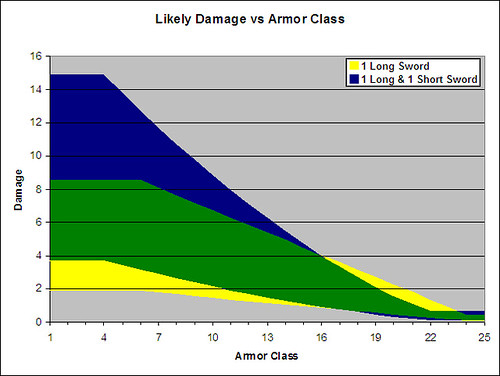
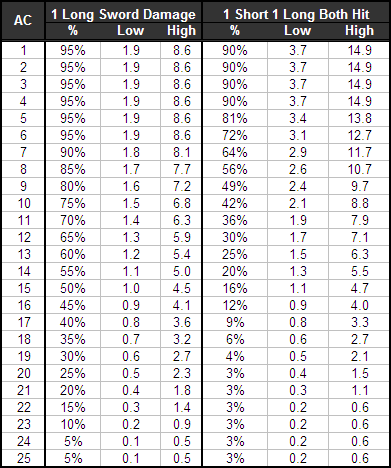
The implementation of Armor is class is nothing less then excellent, well thought out and easy to calculate.
This is a little complicated to understand but it is completely logical once you digest the rules. It can be a bit tricky to calculate on the spot, but it is so completely fair I can not judge it harshly.
3.5/D20 has no shortage of depth of detail. Just looking at the long lists of weapons, armor, equipments, skills, spells and feats can be exhausting, but clearly this depth adds to realness of the game and helps players customize their character to the nth degree!
If you have never heard of it, GURPS is a universal RPG similar to D20, but based on 3d6 instead of a twenty sided die. It pre-dates D20 by at least 15 years and has modules for every environment you can imagine. D20 over took it as the universal RPG system of choice because D&D is the most popular and D20 is a free system that encourages player contribution to the community. I do still play in a Gurps campaign but I am at a best a newbie with regard to the rules.
Gurps makes heavy use of concept called “the Gap”. Effectively how well or how poorly you make a skill check impacts the result. It took a little getting used to for me, but it is more efficient and takes less time in play. A very cool concept indeed!
For those who don’t know, Top Secret was an early 80’s D20-ish, James Bond RPG published by TSR. It was not a great game, vague rules and overly complicated hand to hand melee. I played it a few years and then abandoned it.
In a world with out “Cure Light Wounds” and weapons like machine guns and rocket propelled grenades. Damage to players was frequently lethal. The game had the concept of “Fame & Fortune” points. These points, of which you had very few, let the player who had just been killed, think of a fluky way to not be dead. There was something like a 10 second rule to avoid long pondering delays. But the rule worked, presuming the player was creative enough to think of something. The GM would sometimes say “No, that’s too absurd, try again.” Still the rule worked mainly because it was so easy to get killed in the game.
Top Secret S.I. (Special Investigation) came out in the late 1980’s and was a complete replacement for the original game. All in all it was good game, well balanced rules fast combat and sufficient depth to be a commando, spy, thief, cop or whatever in the modern day. For a more detailed review: RPG Top Secret S.I Review
The makers abandoned the traditional concept of hit points. They replaced it with a zone chart of ten areas covering: Head, Left Chest, Right Chest, Abdomen, Right Arm, Left Arm, Right Hand, Left Hand, Right Leg and Left Leg. Furthermore they had two types of damage: wound or bruise. I won’t go into all the details, but they effectively solved the problem from the original game “being too easy to die”. Body Armor, cover and good common sense would sustain a character a good long time in heavy combat. Furthermore the chart was cool, superimposed over a silhouette of man.
There are no classes in this system, but they had a large list of skills. Some skills had pre-requisite skill(s) and each skill had a cost to it. This worked really well with their experience system, as players were rewarded with skill points and could improve their abilities or get new ones. The skills were easy to understand resulting in a nice neat uncomplicated system for skills.
TPSI diverged from the D20 model here by doing everything on percentile basis. Sometimes the math would get dodgy it made your attributes very easy to understand. Most people have no problem understanding that 10% chance is not as good as 80% chance. In that sense the system had an intuitive quality that’s hard to beat.
That sums it up for me, naturally I could have said more about each system. Those elements I highlighted are IMO the great concepts in those games.
I attempt to articulate what the existing problems are with D20 specifically and RPGs in general. These are based on my experiences trying to teach and recruit new players.
There is a certain geek factor associated with Role Playing Games that in my experience is untrue and unfair. Not surprising the stereotypes about non-hygienic, socially inept, devil worshiping, poorly dressed boys or scary adult men persists. I won’t pretend to have any plan to deal with that, except to say that I lead by example. Certainly myself and the people I play with exhibit none of those qualities.
If a new player manages to overcome the geek factor prejudice and decides to make a go of it, without a mentor they are likely doomed to quit. They are forced to wade through an avalanche of rules, terms, lists, tables, charts, choices resulting in a near endless array of decision points whose implications are completely unknown. In my experience the player already has in mind some type of character they want to be. This is character is probably derived from a book, movie or video game.
This may be the number one complaint I endured, and I am not certain why it happens now and did not happen in the 1970’s. Perhaps its video games or CNN or FOX News or I do not know what. But the problem boils down to this quote from an exasperated teenager: “If I shoot an arrow into my enemies head, he is dead weather he is level 1 or level 10, but in this game my enemy could be buck naked, 10th level and take shots from my bow all day. That’s just stupid.” I am inclined to agree. As a follow up a great d20 hit points debate went on at a forum I visit.
I believe that 3.5/D20 did a great job with armor class. It is a great improvement over before, but the flip side of armor class is “chance to hit” and that is no small feat to calculate for a novice. You have an adjustment for Strength (check a chart), adjustment for opponent size (check a chart), adjustment for weapon proficiency (check a chart), adjustments for related feats (check a chart) and finally adjustments for the quality of the weapon. Did I miss any? Probably I did but the point is, that all those adjustments are neat, perhaps more accurate, but cumbersome to know, find and use. It is not fun if it takes 10 minutes to know you need to beat a 12 to hit.
“So I have 50 hit points, and I keep taking damage in melee. But there are no adjustments to my skills until I reach zero, at which point I collapse and can’t use any of my skills.” Where as this is true, I can not say it ever bothered me personally. I think the thinking is the direct impact of video games, and 3d shooters where you ability degrades as you take damage. The comment makes sense to me but in 3.5/D20 it would be very cumbersome to account for.
The 3.5/D20 system has a lot of rules. The rules are written with excessive verbosity, a weird dual gender mode and they are poorly organized. You often need to be in two or three places in the rules to answer a single question. If you play every week that becomes less of a problem, if you are older and play less often it can get frustrating. Thank you for the internet because one resource is invaluable for making quick use of the rules: HyperText d20 SRD I often remind youngsters that the 3.5/D20 rules are a vast improvement in consistency over the AD&D rules of long ago, but a newbie does not care about yesterday!
I think the problems are specifically targeted to the required interdependency of rules with regards to race, class, level, feat and skills involved with just creating a character. These complexities are revisited at the first melee. I whole hearted agree with the richness the D20 designers provided, but the complexity is a lot to digest for a newbie.
 D100
D100


