Recently I played in a very spirited campaign. All involved were experienced and the characters had been in use off and on for many years. However this time the campaign was played using a VGT (Virtual Game Table) called Maptool for the first time. There was a noticeable change in player behavior and this was completely due to the lack of light which Maptool does an excellent job of representing.
Traditionally on the table top, the map is revealed in bit and pieces as the characters "See" more, using either torches, lanterns, light spells or whatever. We more or less took the light for granted and it rarely slowed the pace of the party in exploration or melee. In fact rarely did light effect player behavior or impact die rolls. This was really a convenience for both GM and the players. It had been going on for so long that none of us even thought it about it any longer.
However in last weekends play something amazing happened. The players were, for lack of better word, Timid! In more then one example the strong fighter type would blitz after a foe and stop. Thats right STOP at the edge of the light. I can't recall that ever happening before. Furthermore our sources of light were limited to certain characters and the other characters tended to bunch up, bathing in the warm glow of thelight. Furthermore in a large and dark cavern. The characters were easy targets for foes outside the light with melee weapons. This is new behavior and really added to the fun!
None of this really has anything to do with developing a RPG, but it was such a powerful and positive experience I had to share the effect. I recommend that if you have not used a VGT you try one out sometime soon. We used Maptool which is free, works on multiple platforms, is easy to install, and not too difficult to learn to use.
Showing posts with label RPG. Show all posts
Showing posts with label RPG. Show all posts
Friday, January 18, 2008


Tuesday, November 20, 2007
The question of class
An early question for us was if the system should have character classes or not. I was strongly opposed to having class system but we debated it for quite a long while. Classes do provide certain benefits, that make the rules easier to construct. Our decision was that these benefits to the writer of the rules were not really a benefit to the player in any appreciable way, so we ultimately decided to have no classes in D100 Melee System.
If you do not have a class does this mean all your characters end up being strange hybrid characters with odd mixes of abilities?
The truth is, that it could. In play testing thus far, it has not worked out that way. In fact quite the opposite. For the most part characters start out as generalists that stand a fair chance of surviving melee. However as each character grows (and they grow quickly) they develop specific abilities that they need to achieve their personal and also party goals. Effectively creating reasonably skilled generalist with terrific specialized skills in areas the party believes it needs.
So how does it work without a class to define the character?
It is actually really simple. Instead of classes, class abilities, class feats, class restrictions and class bonuses. You have a long list of skills. All skills are based on an attribute: Strength, Intelligence, Will Power, Reflex, Constitution, Charisma, Dexterity and Movement. The character acquires the skill and gains the ability. The character can continue to invest in the skill and improve the ability if they so choose. No skills are restricted, no ability in one skill prohibits an ability in another skill. The only cheviot is that some skills have pre-requisites. In other words some skills require that you first obtain another skill to get it.
If you do not have a class does this mean all your characters end up being strange hybrid characters with odd mixes of abilities?
The truth is, that it could. In play testing thus far, it has not worked out that way. In fact quite the opposite. For the most part characters start out as generalists that stand a fair chance of surviving melee. However as each character grows (and they grow quickly) they develop specific abilities that they need to achieve their personal and also party goals. Effectively creating reasonably skilled generalist with terrific specialized skills in areas the party believes it needs.
So how does it work without a class to define the character?
It is actually really simple. Instead of classes, class abilities, class feats, class restrictions and class bonuses. You have a long list of skills. All skills are based on an attribute: Strength, Intelligence, Will Power, Reflex, Constitution, Charisma, Dexterity and Movement. The character acquires the skill and gains the ability. The character can continue to invest in the skill and improve the ability if they so choose. No skills are restricted, no ability in one skill prohibits an ability in another skill. The only cheviot is that some skills have pre-requisites. In other words some skills require that you first obtain another skill to get it.
Wednesday, June 13, 2007
D100 Damage and Hit Point Model
D100 Taking Damage
Overview of Damage and Damage Avoidance
A character never gains hit points. A player can improve their ability to survive in two ways: skills and armor. Armor provides a direct reduction in damage. Skills allow the player to avoid a blow all together, or deflect a blow to a non deadly or more heavily armored part of the body. Both skill and armor vastly improve the survivability of the character. As the characters skills improve the reliance on heavy armor decreases.
Damage Reduction from Armor
Each armor type has a fixed damage reduction value. The reduction value is a direct 1:1 deduct in the damage received by the character. For example if an armor has a damage reduction of 4 (DR=4) and the character takes 6 points of damage, that damage is reduced by 4. The character takes 2 points of damage. That is all there is to damage reduction from armor. It gets no more complicated then that!
Simple Damage Avoidance from Skill(s)
In the simplest terms D100 melee is similar to a D20 opposed skill check. If the attacker makes a successful skill check, the defender makes their skill check. If the defender succeeds the attack is blocked, if the defender fails the blow lands and armor’s damage reduction is applied.
Damage and Body Zones
“But what about the 10 zones on the body?” you say. Say no more for here it is explained. Each body part in the 10 zones has the same amount of points for damage, based on the Constitution. However each body part may not be equally protected. For example the character may have a chain hood, breast plate, and hide covering the arms and legs. Each of those armor types has its own damage reduction, and so those body zones have different damage reduction values. On the surface this may sound complicated but in practice with the zone chart (See Below) it is easy to record and track.
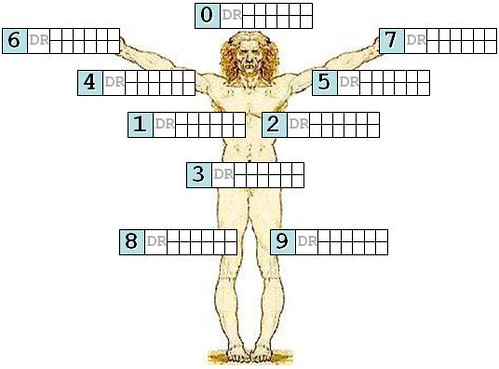
Bumping Damage with Skill
Bumping allows the character to move damage from one zone to another zone. So a blow to zone 3 (stomach) could be moved to a non lethal zone or to a better armored zone. Bumping only comes into play if the defender fails to block the blow.
Bumping is a double edged sword, the attacker can bump a successful blow to a less armored and/or more lethal zone. Bumping still favors the defender as the attacker bumps first. The number of bumps is determined by the skill level.
In Conclusion
The combination of damage zones, armor, skill and skill bump combine to improve the survivability of the character through both armor and skill with increasing the amount of damage the player can absorb. This damage model is easy to apply, easy to explain and follows common sense. The damage zone chart facilitates the allocation of damage and damage reduction in an easy to manage visual way.
 D100
D100
Friday, June 8, 2007
D100 Hit Points
D100 - Tackling the problem of hit points
D20 Theory and Problem
The hit points in D20 represent many things: constitution, endurance, experience, luck and skill. It is not really that high level character can take more damage then a low level character. It is more accurate to say that the high level character is able to lessen the effect of damage through their skill and experience. D20 models this by increasing the hit points with each class level. The system works but is not perfect. There are two problems I endeavor to solve and best summed up with quotes below.
No Diminished Capacity Until Unconscious
“So I have 50 hit points, and I keep taking damage in melee. But there are no adjustments to my skills until I reach zero, where in I collapse and can’t use any of my skills.”
Tends Break Down Outside Normal Melee
“If I shoot an arrow into my enemies head, he is dead weather he is level 1 or level 10, but in this game my enemy could be buck naked, 10th level and take shots from my bow all day.”
D100 Solution to Hit Points
Rather then tackle these problems separately we dealt with them simultaneously by borrowing some from the Top Secret S.I. model for damage by zone. A character’s body is divided into 10 zones. Each zone has the same number of points. The number of points per zone is based on the character’s constitution.
D100 Zone Chart
Diminished Capacity Solved
Should a player loose all the points in any of 4, 5, 6, 7, 8 and/or 9; that part of the body becomes unusable for an action. Without an arm or hand, a bow can not be plucked. With out a leg, the character can not run or even stand easily. Without a hand or arm the sword can not be wielded etc.
Break Down outside Normal Melee Solved
A character’s capacity for damage per zone never increases, regardless of skill level. A character that has lost all the points in zones 0, 1, 2 and/or 3 is effectively killed. The character’s skills, armor and luck will help the character avoid damage but the amount of damage the body can absorb does not change.
In Conclusion
In future posts I will explain the impacts of skills and armor on damage avoidance. The points per zone concept has gone through many iterations in play testing, some better models became overly cumbersome for players. This concept is a fair balance between playability and realism.
D100
Wednesday, June 6, 2007
D100 Goals
What are the goals of the D100?
An RPG is first and foremost a game. As a game it should be fun. It is my opinion that a great Role Playing Game (RPG) creates a universe where the imagination can play. The minds of Players and the Game Master should not be over burdened with the intricacies and trivialities of an overly modeled universe of rules. So my primary goal is to get the rules out of the way, and allow the game master to judge the situation at hand and not need to consult a rule. After all games should be fun, let players play and the game master dream!
My theory on a good Role Playing Game
It is my opinion that a Role Playing Game is a model of life. All RPG systems boil down to these major elements: Attributes, Skills (abilities), and Skill checks. These components define most everything or anything that is or happens in the game’s universe. Most everything thing else can be in lists or made up on the fly by the Game Master. To anyone with some experience with an RPG this is obvious but it is important to understand that uninitiated have never seen this before and the introduction can be over whelming.
What do the rules actually do?
The rules are supposed to create a certain amount of predictability in the game. Players and game masters can access, generally by intuition, the relative risk of the situation and decide what to do. You still roll dice the rules simply set down the odds.
The new RPG system has the following goals:
- Be able to create a character and explain the basic mechanics of the game in 15 minutes or less.
- The rules must be simple, straight forward, well organized and with clear examples.
- The character sheet will fit easily on 1 side of a single sheet of paper.
- Melee will be fast and easy to understand.
- Hit Points will better model reality and not increase with experience.
- Rules complexity will be optional and not required for game play. This allows those interested in greater depth to have it and the rest to proceed without it. Complexity is not the enemy. In fact it can really enhance the fun so long as all understand them. Required complexity is to be avoided.
In conclusion:
There it is, the guiding principles behind an entire year of labor.
D100
Sunday, June 3, 2007
Introducing the D100!
D100 - A New Universal Role Playing Game System
This concept was started in the spring of 2006, by three long time players of RPGs. D100 aspires to be: free, open, simple, quick and fun. It take elements of many other systems and combines them into a single straight forward and consistent system. The systems that inspired D100 are: GURPS, AD&D, D20 and Top Secret SI. Intense play testing has been going on for three months. The basic system will be released to the public in draft form Fall 2007 under the Creative Commons Licence.
More information will be made available here and on the release site www.rolldamage.com as the summer goes on.
Balancing Role Playing in a RPG
Yesterday I played in a campaign and the GM made an interesting comment as things were wrapping up.
"When I first starting playing with you guys, I came to realize that you were old school players... You know the 'clear the dungeon' types."
I think he means our little group prefers melee to actual role playing. I concluded at least for me, that it is correct. I prefer as a player to do a skill check to achieve a goal then to actually act it out, why else have the skill?. Most times: diplomacy, interrogate, intimidate, gather information suffice. I do admit I enjoy in character banter (accents and all), especially when the party is haggling over a fee or getting the details of a mission, but I don't like to do it every time.
So my conundrum is this:
As a player I don't like to role play much.
As a game master I like to role play a lot.
I believe that as a player I really just want melee most of time, yet as a Game Master I want to build a rich tapestry for the players.
More at: Balance Role Play in an RPG
"When I first starting playing with you guys, I came to realize that you were old school players... You know the 'clear the dungeon' types."
I think he means our little group prefers melee to actual role playing. I concluded at least for me, that it is correct. I prefer as a player to do a skill check to achieve a goal then to actually act it out, why else have the skill?. Most times: diplomacy, interrogate, intimidate, gather information suffice. I do admit I enjoy in character banter (accents and all), especially when the party is haggling over a fee or getting the details of a mission, but I don't like to do it every time.
So my conundrum is this:
As a player I don't like to role play much.
As a game master I like to role play a lot.
I believe that as a player I really just want melee most of time, yet as a Game Master I want to build a rich tapestry for the players.
More at: Balance Role Play in an RPG
Friday, June 1, 2007
What is to like about RPG’s?
What’s to like about RPG’s?
It occurs to me that all of my entry’s to date have been rather negative. That does not represent how I feel about d20. I like the D20 system! I am merely highlighting the problems I encounter when training new players. So today’s post is different. I am going to highlight the qualities of various systems that I believe work really well.
Dungeons and Dragons 3.5 / D20
The depth of the game is vast and it is hard for me single out a few specific things but none the less I will.
Armor Class 3.5/D20
The implementation of Armor is class is nothing less then excellent, well thought out and easy to calculate.
Opposed Skill Check 3.5/D20
This is a little complicated to understand but it is completely logical once you digest the rules. It can be a bit tricky to calculate on the spot, but it is so completely fair I can not judge it harshly.
Depth of Detail 3.5/D20
3.5/D20 has no shortage of depth of detail. Just looking at the long lists of weapons, armor, equipments, skills, spells and feats can be exhausting, but clearly this depth adds to realness of the game and helps players customize their character to the nth degree!
Gurps
If you have never heard of it, GURPS is a universal RPG similar to D20, but based on 3d6 instead of a twenty sided die. It pre-dates D20 by at least 15 years and has modules for every environment you can imagine. D20 over took it as the universal RPG system of choice because D&D is the most popular and D20 is a free system that encourages player contribution to the community. I do still play in a Gurps campaign but I am at a best a newbie with regard to the rules.
The Gap in Gurps
Gurps makes heavy use of concept called “the Gap”. Effectively how well or how poorly you make a skill check impacts the result. It took a little getting used to for me, but it is more efficient and takes less time in play. A very cool concept indeed!
Top Secret by TSR
For those who don’t know, Top Secret was an early 80’s D20-ish, James Bond RPG published by TSR. It was not a great game, vague rules and overly complicated hand to hand melee. I played it a few years and then abandoned it.
Fame & Fortune Points in Top Secret
In a world with out “Cure Light Wounds” and weapons like machine guns and rocket propelled grenades. Damage to players was frequently lethal. The game had the concept of “Fame & Fortune” points. These points, of which you had very few, let the player who had just been killed, think of a fluky way to not be dead. There was something like a 10 second rule to avoid long pondering delays. But the rule worked, presuming the player was creative enough to think of something. The GM would sometimes say “No, that’s too absurd, try again.” Still the rule worked mainly because it was so easy to get killed in the game.
Top Secret S.I. by TSR
Top Secret S.I. (Special Investigation) came out in the late 1980’s and was a complete replacement for the original game. All in all it was good game, well balanced rules fast combat and sufficient depth to be a commando, spy, thief, cop or whatever in the modern day. For a more detailed review: RPG Top Secret S.I Review
Damage by Zone in Top Secret S.I.
The makers abandoned the traditional concept of hit points. They replaced it with a zone chart of ten areas covering: Head, Left Chest, Right Chest, Abdomen, Right Arm, Left Arm, Right Hand, Left Hand, Right Leg and Left Leg. Furthermore they had two types of damage: wound or bruise. I won’t go into all the details, but they effectively solved the problem from the original game “being too easy to die”. Body Armor, cover and good common sense would sustain a character a good long time in heavy combat. Furthermore the chart was cool, superimposed over a silhouette of man.
Skills and Classes
There are no classes in this system, but they had a large list of skills. Some skills had pre-requisite skill(s) and each skill had a cost to it. This worked really well with their experience system, as players were rewarded with skill points and could improve their abilities or get new ones. The skills were easy to understand resulting in a nice neat uncomplicated system for skills.
Attributes
TPSI diverged from the D20 model here by doing everything on percentile basis. Sometimes the math would get dodgy it made your attributes very easy to understand. Most people have no problem understanding that 10% chance is not as good as 80% chance. In that sense the system had an intuitive quality that’s hard to beat.
In Conclusion:
That sums it up for me, naturally I could have said more about each system. Those elements I highlighted are IMO the great concepts in those games.
Thursday, May 31, 2007
First, Defining the D20 problems
What's not to like about RPGs?
I attempt to articulate what the existing problems are with D20 specifically and RPGs in general. These are based on my experiences trying to teach and recruit new players.
Geek Factor
There is a certain geek factor associated with Role Playing Games that in my experience is untrue and unfair. Not surprising the stereotypes about non-hygienic, socially inept, devil worshiping, poorly dressed boys or scary adult men persists. I won’t pretend to have any plan to deal with that, except to say that I lead by example. Certainly myself and the people I play with exhibit none of those qualities.
Creating a Character
If a new player manages to overcome the geek factor prejudice and decides to make a go of it, without a mentor they are likely doomed to quit. They are forced to wade through an avalanche of rules, terms, lists, tables, charts, choices resulting in a near endless array of decision points whose implications are completely unknown. In my experience the player already has in mind some type of character they want to be. This is character is probably derived from a book, movie or video game.
Hit Points
This may be the number one complaint I endured, and I am not certain why it happens now and did not happen in the 1970’s. Perhaps its video games or CNN or FOX News or I do not know what. But the problem boils down to this quote from an exasperated teenager: “If I shoot an arrow into my enemies head, he is dead weather he is level 1 or level 10, but in this game my enemy could be buck naked, 10th level and take shots from my bow all day. That’s just stupid.” I am inclined to agree. As a follow up a great d20 hit points debate went on at a forum I visit.
What do I need to hit?
I believe that 3.5/D20 did a great job with armor class. It is a great improvement over before, but the flip side of armor class is “chance to hit” and that is no small feat to calculate for a novice. You have an adjustment for Strength (check a chart), adjustment for opponent size (check a chart), adjustment for weapon proficiency (check a chart), adjustments for related feats (check a chart) and finally adjustments for the quality of the weapon. Did I miss any? Probably I did but the point is, that all those adjustments are neat, perhaps more accurate, but cumbersome to know, find and use. It is not fun if it takes 10 minutes to know you need to beat a 12 to hit.
Hit Points Again
“So I have 50 hit points, and I keep taking damage in melee. But there are no adjustments to my skills until I reach zero, at which point I collapse and can’t use any of my skills.” Where as this is true, I can not say it ever bothered me personally. I think the thinking is the direct impact of video games, and 3d shooters where you ability degrades as you take damage. The comment makes sense to me but in 3.5/D20 it would be very cumbersome to account for.
Too Many Rules poorly described
The 3.5/D20 system has a lot of rules. The rules are written with excessive verbosity, a weird dual gender mode and they are poorly organized. You often need to be in two or three places in the rules to answer a single question. If you play every week that becomes less of a problem, if you are older and play less often it can get frustrating. Thank you for the internet because one resource is invaluable for making quick use of the rules: HyperText d20 SRD I often remind youngsters that the 3.5/D20 rules are a vast improvement in consistency over the AD&D rules of long ago, but a newbie does not care about yesterday!
In Conclusion
I think the problems are specifically targeted to the required interdependency of rules with regards to race, class, level, feat and skills involved with just creating a character. These complexities are revisited at the first melee. I whole hearted agree with the richness the D20 designers provided, but the complexity is a lot to digest for a newbie.
Tuesday, May 29, 2007
The long road to wanting a new RPG System
Greetings!
I have a good job, a great marriage and awesome kids. I have been playing RPGs (Role Playing Games) since the late 1970's. I really enjoy the escapism aspect of being someone else in some other place on some other world in some other time. In the early days I played nearly all the old TSR games: Dungeons & Dragons, Top Secret, Traveler, Gama World. They were each good games with their own strengths and weaknesses.
Along came Dungeons and Dragons Version 3 which was a completely revised rules set. In short I hated it. It was too different, indeed it was a whole new game. I respected what they tried to do with making the mechanics of the game consistent. However they kept many of the complexities with respect to classes and race restrictions and so in total I did not use the new system. A short time later Dungeons and Dragons Version 3.5 came about as a major revision. It is a vast improvement and I liked it so much that I started to use it.
Around this I first encountered the D20 system. D20 System is effectively the open source equivalent of Dungeons and Dragons. However the creators are brilliant. They built D20 as a universal game system, not specifically tied to the fantasy (Tolkien) genre. D20 has many modules and variants that let you play in the far future, the wild west or as 007 to name a few. The genius of this concept is clear. Learn 1 system, apply it to your favorite genre and game game game!
When I was younger, with no mortgage, no family and few if any real responsibilities; I didn't have much trouble transitioning between different game rules on the fly. I'm much older now, have far less time and my memory is not what it used to be. Switching between game systems is not really and option anymore. I do not want to always play the Tolkien Fantasy of Dungeons and Dragons either, some times I'd rather be James Bond or Han Solo. D20 universal role playing system attracted me instantly.
The D20 glow wore off quickly. At the same time I decided to switch to D20, I was starting to teach my kids and their friends how to play. What I came to understand was that I had a tremendous legacy of knowledge about RPG systems. This knowledge base meant that I already had an understanding of the concepts common to all rules systems. For me it was a matter of applying new mechanics to already well understood concepts. For my kids who had no such knowledge base, it was a struggle. Kids being kids, they questioned everything. Then one day about a year ago I realized that most all their beefs were fair and well reasoned.
I went to my friends and discussed the D20 issues. It was an even split. Half rejected the very thought of new ideas and half became curious as to how the mechanics could be altered. The ideas bubbled around in a various discussions for several weeks and then we started to construct some rules!
What has surprised me most about the journey this far is how very hard it is to create a Role Playing Game. I will post more next weekend!
"It has always been easier to destroy then to create." - Mr. Spock
D100
I have a good job, a great marriage and awesome kids. I have been playing RPGs (Role Playing Games) since the late 1970's. I really enjoy the escapism aspect of being someone else in some other place on some other world in some other time. In the early days I played nearly all the old TSR games: Dungeons & Dragons, Top Secret, Traveler, Gama World. They were each good games with their own strengths and weaknesses.
Along came Dungeons and Dragons Version 3 which was a completely revised rules set. In short I hated it. It was too different, indeed it was a whole new game. I respected what they tried to do with making the mechanics of the game consistent. However they kept many of the complexities with respect to classes and race restrictions and so in total I did not use the new system. A short time later Dungeons and Dragons Version 3.5 came about as a major revision. It is a vast improvement and I liked it so much that I started to use it.
Around this I first encountered the D20 system. D20 System is effectively the open source equivalent of Dungeons and Dragons. However the creators are brilliant. They built D20 as a universal game system, not specifically tied to the fantasy (Tolkien) genre. D20 has many modules and variants that let you play in the far future, the wild west or as 007 to name a few. The genius of this concept is clear. Learn 1 system, apply it to your favorite genre and game game game!
When I was younger, with no mortgage, no family and few if any real responsibilities; I didn't have much trouble transitioning between different game rules on the fly. I'm much older now, have far less time and my memory is not what it used to be. Switching between game systems is not really and option anymore. I do not want to always play the Tolkien Fantasy of Dungeons and Dragons either, some times I'd rather be James Bond or Han Solo. D20 universal role playing system attracted me instantly.
The D20 glow wore off quickly. At the same time I decided to switch to D20, I was starting to teach my kids and their friends how to play. What I came to understand was that I had a tremendous legacy of knowledge about RPG systems. This knowledge base meant that I already had an understanding of the concepts common to all rules systems. For me it was a matter of applying new mechanics to already well understood concepts. For my kids who had no such knowledge base, it was a struggle. Kids being kids, they questioned everything. Then one day about a year ago I realized that most all their beefs were fair and well reasoned.
I went to my friends and discussed the D20 issues. It was an even split. Half rejected the very thought of new ideas and half became curious as to how the mechanics could be altered. The ideas bubbled around in a various discussions for several weeks and then we started to construct some rules!
What has surprised me most about the journey this far is how very hard it is to create a Role Playing Game. I will post more next weekend!
"It has always been easier to destroy then to create." - Mr. Spock
D100
Subscribe to:
Posts (Atom)
